Dead Internet is Coming (But Until then let's place in AI Search)
In a world where we are constantly being sold to via emails, ads, thoughtleader content / influencers, and more, there’s one channel that stands out most - the ability for your customers to find you on their own.
![MEME ORIGIN] LET ME IN - Eric Andre Meme - YouTube](https://substackcdn.com/image/fetch/$s_!8yRS!,f_auto,q_auto:good,fl_progressive:steep/https%3A%2F%2Fsubstack-post-media.s3.amazonaws.com%2Fpublic%2Fimages%2Ff3951b93-06e5-4e6a-8329-2b730f59c034_640x480.jpeg "MEME ORIGIN] LET ME IN - Eric Andre Meme - YouTube")
This is why I firmly believe in investing in your website, brand, and creating community early → I’m a huge fan of the team at Default and their product’s ability to build infrastructure for inbound pipeline gen for this reason.
I lead our focus on inbound from the very start at Galaxy, by putting tons of time into our website, holding weekly events, even promoting jobs for our users, etc.
My time at Unify was spent mostly focusing on outbound automation. Intent signal scraping (using tools like Phantombuster and Captain Data), orchestration (using Unify and Clay), the outbound itself (using Unify’s sequencing), deliverability and reporting (using homegrown data analytics dashboards in Redash, part of the difficulty of doing so which was the inspiration for Galaxy), and other sales enablement / revops work.
I had no idea how to effect change on the Inbound channel.
When I started working on Galaxy, it was really up to me alone to identify areas we could generate demand and interest and then go and act on it.
For devtools, there are only a few buckets of demand generation that we could easily spend time working on while we bootstrapped. Product-led growth, community building, and finally search-engine optimization (SEO).
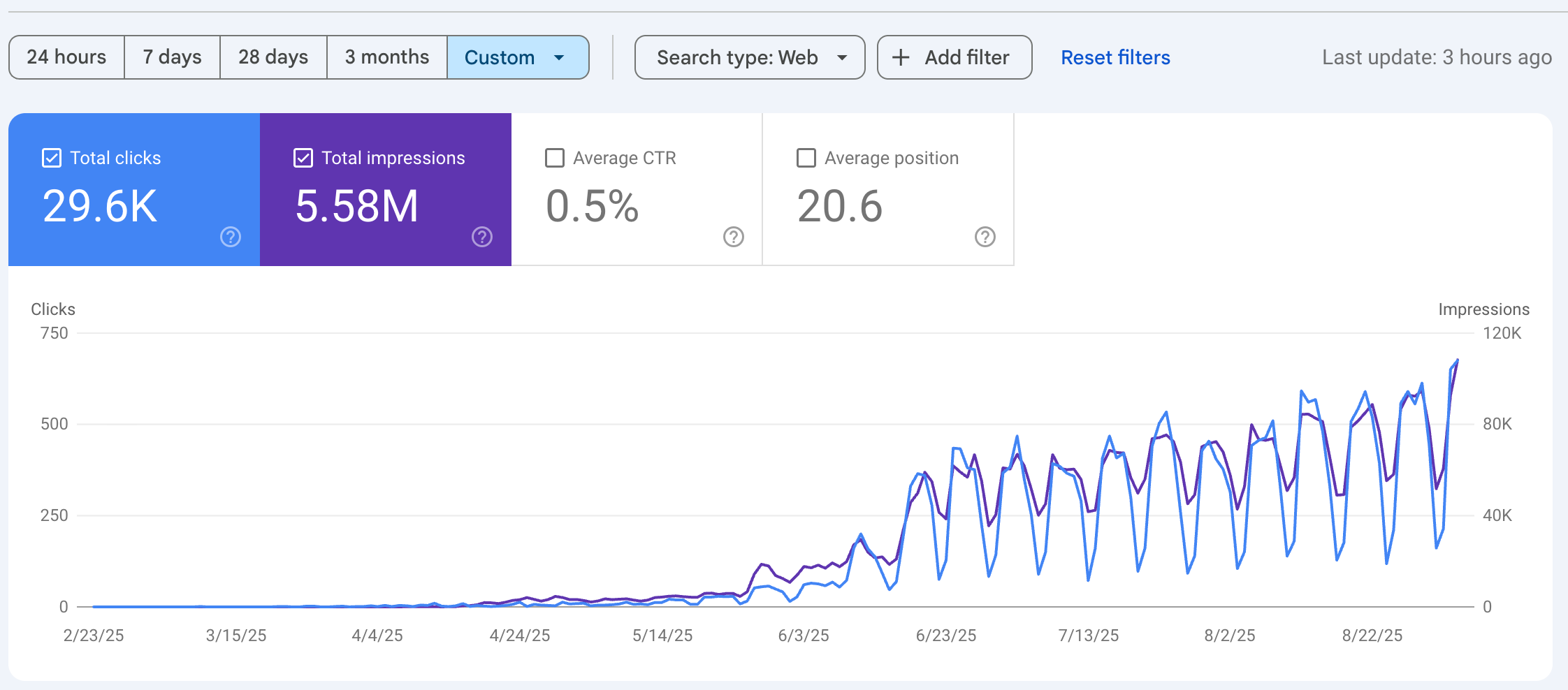
I did tons of reading over the course of a month to learn more about SEO, AEO, and more. And even after my departure (cofounder breakup), Galaxy is mere hours away from hitting 10M impressions and 65K+ clicks in the last 8 months.
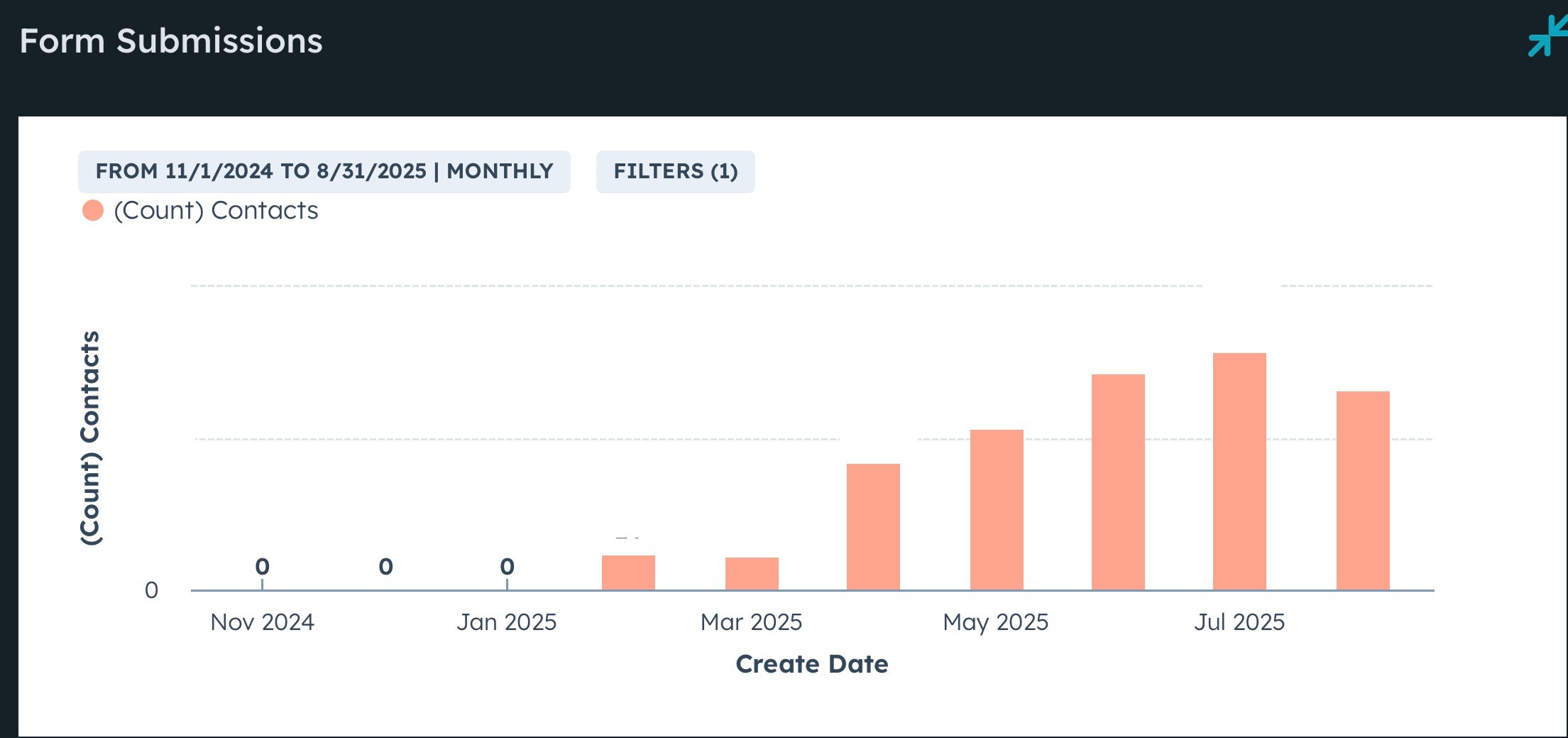
This type of exposure has resulted in thousands of signups / downloads per month from my work. I’m going to share my breakdown of the best practices below so that you can emulate them from a standalone GTM engineer and operator.
SEO Principles
When most people think of SEO, they still think about gaming Google - keyword stuffing, backlinks, meta tags. But that’s not the game anymore. Modern SEO is about clarity: telling both humans and machines what your product is, why it exists, and who it’s for - and doing it in a way that compounds over time.
It starts with language. Use the words your users actually type, not the ones you wish they did. At Galaxy, we originally called the product a “query client.” No one searched for that. People searched for “SQL editor,” “data workspace,” and “PostgreSQL client.” That small realization completely reframed how we positioned ourselves and how users found us.

From there, map your keywords systematically - by intent (informational → transactional), length (short-tail vs. long-tail), and type (branded, non-branded, seed, secondary, etc.). A good SEO strategy doesn’t just chase volume; it builds a web of content that catches users wherever they are in the journey. The blog post that educates today becomes the conversion page that sells tomorrow.
I used Ahrefs religiously - to find keywords, check their difficulty, and plan what content would actually move the needle. Once you know what to target, start thinking about how to bring that content to life. For most companies, this looks like a mix of persona-specific use cases, product tours, free tools, learning hubs, job boards, and comparison pages - anything that provides real value and direction for your audience.
Then comes structure. Every page should be clean, fast, and easy to navigate. Use clear heading hierarchy (H1s, H2s, H3s), descriptive URLs (/learn/data-tools not /posts?id=12345), internal links with contextual anchors (“SQL Editor Comparison,” not “click here”), and outbound links to credible sources like dbt or Snowflake.

Under the hood, structure your data with schema - JSON-LD for your Organization, Articles, FAQs, Authors, Jobs, Reviews, and Software Products. Schema helps Google and Bing understand what your site means, not just what it says. I also recommend adding a robots.txt and even an LLM.txt to guide both crawlers and large language models - because the next generation of traffic is already coming from AI systems reading the open web.
One thing I learned the hard way: you can build authority on your site, but the real lift happens when others validate you. When Galaxy started getting mentioned in newsletters, forums, and job boards as “that modern SQL editor,” everything changed. Those external signals - backlinks, brand mentions, co-citations - are the off-page engine of SEO. Build relationships, guest post, and track your referring domains. When a high-reputation site links to you, you borrow some of its authority - what SEOs call “link juice.” (lol). That’s the compounding power of credibility.
Structure isn’t just for machines - it’s for humans. The best-performing content we published at Galaxy always had a Table of Contents, clear sections, and optimized meta tags (titles, descriptions) that matched search intent. Even small details matter: filenames like sql-editor-workspace.jpg with alt text like “modern SQL editor desktop workspace” outperform generic IMG1234.jpg. Every image, video, or asset should have a descriptive filename and alt tag - it helps both accessibility and indexing.
Content quality still rules. Google’s E-E-A-T framework (Experience, Expertise, Authoritativeness, Trustworthiness) is worth paying attention to. Show who wrote each piece, include author bios and credentials, and -when possible - feature real quotes or testimonials from users. This turns marketing copy into proof of expertise.
Don’t overlook technical experience either. With mobile-first indexing, your site needs to load fast and read cleanly on phones. Fonts should be legible, buttons tappable, menus visible, and layouts responsive. Run regular audits with Google Search Console or PageSpeed Insights and fix anything slowing you down.
Finally, break up dense text. Long paragraphs kill engagement. Use bullets, tables, and call-outs to make your content easy to scan. Clear formatting improves dwell time, readability, and crawlability - all ranking signals that add up.
And the golden rule: don’t let your content go stale. Refresh it. Track backlinks. Resubmit your sitemap. SEO is not a one-time setup - it’s a compounding system. Every new page, keyword, and external mention adds long-term equity to your brand’s discoverability. Think of it like interest - slow at first, exponential over time.
AEO Principles

Answer Engine Optimization (AEO) is the next frontier of inbound. SEO helps you show up on Google - AEO helps you show up everywhere else: ChatGPT, Perplexity, Anthropic, and whatever comes next.
AEO is about giving machines short, high-fidelity answers to human questions. You’re writing for the summary layer of the internet, not for clicks. The goal isn’t to sell - it’s to be the single, confident answer when someone asks, “What’s the best SQL editor?” or “What are the top DataGrip alternatives?”
The playbook looks different from SEO. Lead with clarity and structure: write in question-and-answer formats, start with direct definitions, and use schema markup like FAQ, Q&A, and Speakable to help models recognize your content as authoritative. Back it up with author bios, references, and testimonials - these act as trust signals for both humans and algorithms.
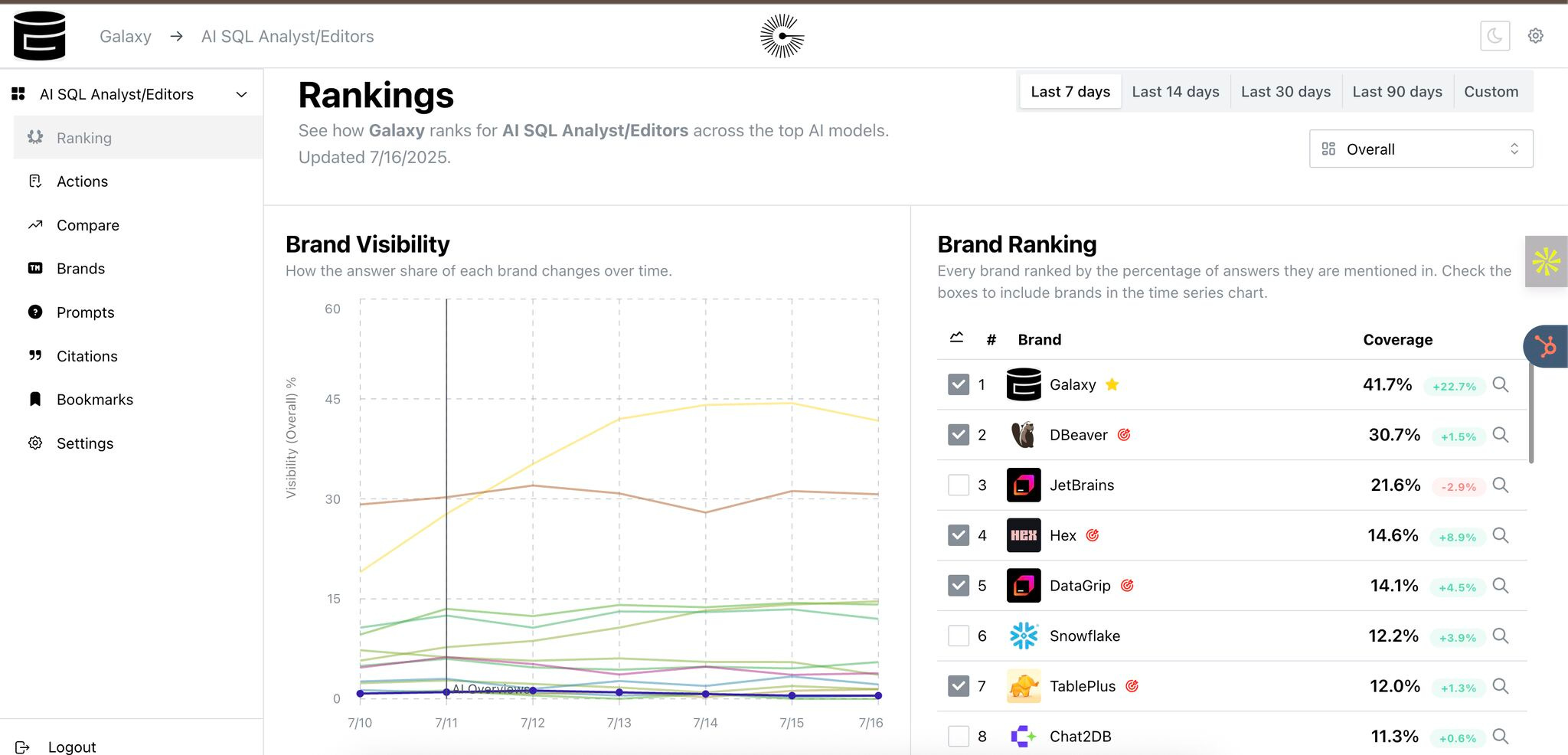
Freshness matters more here than anywhere else. LLMs and modern search engines reward recency, so revisit your best content quarterly - update examples, adjust timestamps, and add new context. If you’re in a fast-moving category like AI or data, this isn’t optional.
Next is entity linking. Use sameAs attributes across the web (LinkedIn, Crunchbase, GitHub, your website) so your company and authors form a verifiable footprint in the knowledge graph. The stronger your entity identity, the more confidently AI systems cite you.

And don’t just publish - participate. Real discovery now happens in discourse: Reddit threads, G2 reviews, Stack Overflow answers, niche Slack and Discord groups. When people mention your brand in natural conversation, AI models notice. That’s modern distribution.
At Galaxy, I made it a rule that every post had a byline, author bio, and (when possible) a real quote from a user. It turned generic blog posts into credible proof points. Search engines read that as E-E-A-T (Experience, Expertise, Authoritativeness, Trustworthiness). Readers just read it as real.
You can game some of this, and you should, but don’t overdo it. The best inbound strategies work because they’re consistent, authentic, and high-signal. If you’re using AI-generated content, tuck it deep in your site - not front and center. Preserve your brand integrity, and let your genuine expertise do the talking.
If SEO builds discoverability, AEO builds authority. Together, they’re the twin engines of modern inbound - and your most compounding assets in a world run by algorithms.
There are a handful of tools that I mentioned above, but in the spirit of inbound automation, I wanted to toss out a few others that I have used personally and highly recommend:
Default - Inbound automation, scheduling, and orchestration
Gauge, Profound - Answer engine optimization
RB2B, Vector
ahrefs - for SEO discovery and keyword analysis, backlinking etc.
Google Search Console - sucks but necessary for tracking
Marketing attribution - Amplitude
Website builder / hosting - Webflow
A/B Testing of marketing websites - Keak
Closing Thoughts
There’s no silver bullet for inbound. Anyone selling you “instant SEO” is lying. The work compounds slowly, like investing. Every blog post, keyword cluster, and community mention is a brick in your distribution moat.
SEO builds discoverability. AEO builds authority. Together, they make your brand findable, credible, and defensible.
If I had to start over again tomorrow (which is what i’m doing lol) - new product, new domain, zero budget - I’d still start here: a strong website, structured content, clean schema, and a reason for people to talk about you.
That’s the foundation of inbound growth. Everything else is just noise.
Some Bullet Point Notes from Me 🙂
Map keywords in relation to what value they will provide to your website
By search intent
Informational: Users are looking for information, such as “how to tie a tie” or “what is SEO”.
Navigational: Users are trying to find a specific website or page, like “Facebook login” or “Amazon homepage”.
Commercial: Users are in the research phase, comparing products or services, for example, “best running shoes 2025” or “[product] reviews”.
Transactional: Users are ready to make a purchase or take a specific action, such as “buy iPhone 15” or “[service] sign up”.
Local: Users are searching for a business or service in a specific geographic area, like “coffee shop near me” or “[city] plumber”.
By length
Short-tail keywords: These are broad, generic terms with high search volume, like “shoes”. They are often difficult to rank for.
Long-tail keywords: These are longer, more specific phrases that have lower search volume individually but are easier to rank for, such as “waterproof trail running shoes for women”.
By other strategic factors
Branded: Keywords that include a specific brand name, such as “Nike running shoes”.
Non-branded: Keywords that do not include a brand name, such as “best running shoes”.
LSI (Latent Semantic Indexing): Keywords that are semantically related to a main topic, which helps search engines understand the context of your content.
Seed keywords: The basic, core terms that you build keyword research from.
Primary keywords: The main keyword a specific page is targeting.
Secondary keywords: Supporting keywords that are related to the primary keyword and add more context to a page
Populate JSON LDs for
Organization
FAQs
Article
Author
BreadCrumb List
Event
Job Posting
Profile Page
Q&A
Review Snippet
Software App
Speakable
Table of Contents
Meta Tag and Meta Description
Image Tags
Internal Linking wherever possible with descriptive anchor text (“SQL Editor Comparison”) - not “click here”.
Mobile breakpoint optimization
Create keyword pillars
Highly structured
bullets, tables, etc.
Notes
Determine the words used to define / describe what your product is / does
Determine what words your competitors use to define / describe their product
Use a tool like ahrefs to do more keyword discovery and determine what people are actually searching for (Search Volume) and the difficulty of ranking for those keywords (Keyword Difficulty), sometimes what you think might be used to define your product is different from what people actually search for! For example we described Galaxy as a query client and then
Be thoughtful about content you can create on your website to offer value / direction for your users but also to inform about your product.
For this reason, many companies have categories of pages like persona specificUse Cases, product tours, free-tools, job-boards, learn pages, competitor comparisons, and more
Add images with descriptive file names and keyword rich alt text
Use of proper headings and hierarchy (H1s, H2s, H3s, etc.)
Logical navigation
Fast site speed
Table of Contents
Meta Tag and Meta Description
Image Tags
Internal Linking wherever possible with descriptive anchor text (“SQL Editor Comparison”) - not “click here”.
Outbound Links to authoritative external sources (e.g., dbt docs, Snowflake blog).
Make URLs descriptive and clear
/learn/data-tools ✅ not /posts?id=12345 ❌
Mobile breakpoint optimization
Create keyword pillars
Highly structured
bullets, tables, etc.
Backlink and track backlinks
Submit sitemap to Google Search Console and Bing consistently to push updates
Create a robots.txt
Create an LLM.txt
AEO Principles
Try to create short punchier information with answer snippets at the top
Prioritize question and answer format for answer engines
Try to get mentioned in areas of genuine discourse / discussion like Reddit, review sites (G2), etc.
Include authors and testimonials in articles to show reputation / official nature of what has been written
Content recency / refreshes
Create content in relation to specific searchers users might have
What is the best SQL editor
What are the best alternatives to DataGrip
Use sameAs Attributes for Entity Linking
Optimize for mobile