Maybe we aren't thinking big enough… Is it all a search problem?
Admittedly, I have no idea how internet search with AI actually works under the hood. I assume it involves some combination of LLMs, agents, APIs, and a constantly shifting set of data sources, all stitched together to approximate a “search-like” experience with far more nuance than traditional filters or Boolean logic ever allowed.
But even without understanding the plumbing, one thing has become increasingly obvious to me.
A huge number of modern workflows reduce down to the same core problem: finding the right people, companies, or entities at the right moment.

It’s all Search
Working with Unify and Clay, I’ve seen firsthand that sales is, in large part, a “finding the right people” problem. Everything downstream - messaging, sequencing, deliverability, CRM hygiene - matters, but it only matters after you’ve identified who is actually worth reaching out to.
When I first spent time in the recruiting world and came across Juicebox, I had the exact same realization. Recruiting is also, in large part, a “finding the right people” problem. Different personas, different incentives, different workflows, but the same underlying motion: identify a narrow, relevant set of humans and then reach out to them.
That parallel stuck with me.
Then someone clued me into Exa, and more recently Parallel, and it pushed the thought further. Are Unify, Clay, and Juicebox actually thinking big enough? Or more pointedly, are we all thinking about these tools too narrowly?
Is it possible that sales, recruiting, partnerships, research, investing, corp dev, and a dozen other functions are all just different flavors of the same underlying workflow?
Sales is finding and emailing people to sell to
Recruiting is finding and emailing people to recruit
Partnerships is finding and emailing people to partner with
Investing is finding and emailing people to diligence
Research is finding and synthesizing information tied to entities

This is a huge DUH; but truly → the differences are real, but they mostly show up downstream. The top of the funnel looks eerily similar.
What’s fascinating is that we’re already seeing some bleed-over. Juicebox has its own sequencing product that recruiters genuinely like. At the same time, they’ve very clearly not invested in deliverability infrastructure, which is honestly kind of hilarious. It’s a good reminder that what sales teams obsess over does not always map cleanly to what recruiters need. Still, the gravitational pull is there.
Why this idea failed before

The idea of “one tool to rule them all” is not new. Horizontal platforms have tried this many times before, and almost all of them failed for predictable reasons.
They were too generic.
They tried to serve too many workflows at once.
They struggled to define a clear buyer.
And their interfaces collapsed under the weight of competing use cases.
Most importantly, legacy search was brittle. Boolean logic, rigid filters, and pre-defined fields meant you could only search for things you already knew how to describe. Discovery was constrained by the schema, not driven by intent.
AI-powered search meaningfully changes that equation. Intent can now be expressed in language instead of dropdowns. Recall improves dramatically. You can start from unknown unknowns rather than a static list of entities. That alone reopens a category many people had written off as impossible.
Exa Releases Websets…
As far as I can tell, Exa originally positioned itself as a developer-friendly way to call a powerful Search API directly inside your own product. In theory, platforms like Unify, Clay, and Juicebox could all leverage Exa’s AI search infrastructure instead of building and maintaining their own bespoke search systems.
But then something interesting happened.
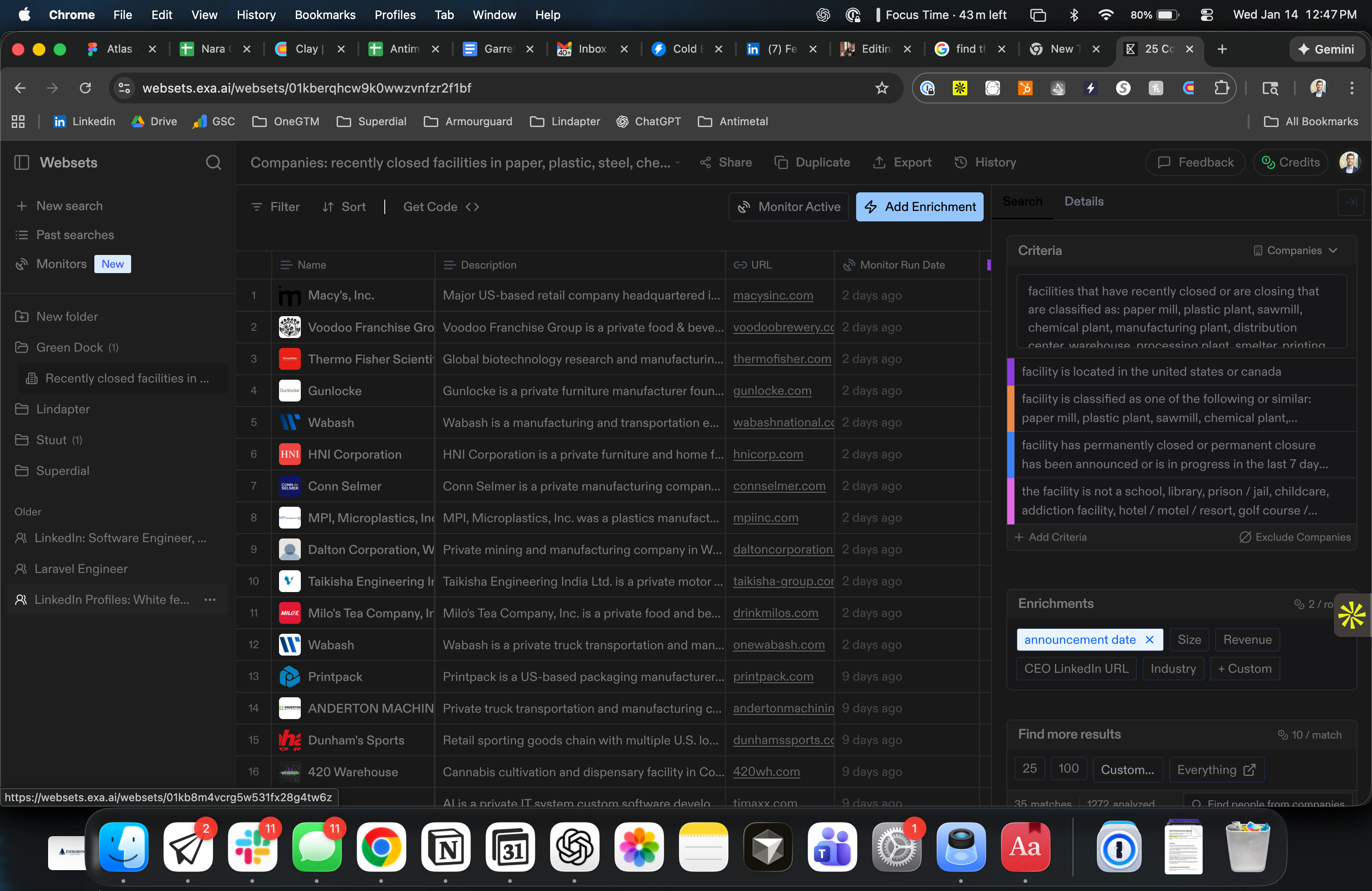
With the rise of GTM influencers, creators, Claygencies, and a growing class of semi-technical operators who live in spreadsheets and tables, Exa released Websets. A Clay-like, table-driven interface for doing AI-powered search. That release caught my attention more than the API itself. And I think it caught many others’s eyes.
Tables are a surprisingly powerful abstraction. They let humans stay in the loop. They make iteration visible. They allow you to reason about search results, scoring, and enrichment in a way that feels tangible rather than magical. Websets felt less like “search as infrastructure” and more like “search as a workflow primitive.”
The Exa team gave me free access for a few months, and I’ve used it to build some genuinely interesting workflows.
First, very fine-tuned LinkedIn and data searches for companies or people, without needing to be an expert in legacy filters or memorizing which dropdown does what. You can express intent in plain language and then refine from there.
Second, news-driven and event-based data tied to companies or people. This is where it got really exciting for me. For example, searching for “manufacturing plants in the USA that produce paper, plastic, or metal that have shut down in the last 12 months.” In Clay, I’ve historically approximated this with RSS feeds, largely because I don’t know which companies even have that signal ahead of time. Using Exa-style search, I surfaced multiple cases Clay never picked up. That gap alone made me pause.
Third, more niche or long-tail data like recent research papers, obscure announcements, or signals that don’t neatly map to existing enrichment providers.
Why tables matter more than they look like they should
Websets is interesting not because it is flashy, but because it is boring in exactly the right way.

Tables are the natural interface for semi-technical operators. GTM teams, recruiters, and researchers have lived in spreadsheets for decades because rows and columns make uncertainty manageable. You can see results. You can tweak assumptions. You can stay in control.
AI wrapped in a table does not feel magical. It feels inspectable. Trustable. Editable.
That matters more than raw capability. Whoever wins the table-native experience often wins distribution, even if their underlying technology is not the most sophisticated.
My Questions
All of this leads me to a set of questions I can’t shake.
Is Exa more excited about being an API company long term, or about Websets as a product? APIs scale quietly and defensibly, but products shape user behavior and expectations.
This is where things get interesting.
Search infrastructure wants to be neutral, invisible, and ubiquitous. APIs scale best when they power everyone quietly in the background. Products, on the other hand, want to own the user, the workflow, and the moment where intent turns into action.
Those incentives are fundamentally at odds. If you power sales tools, recruiting tools, research tools, and internal platforms all at once, staying neutral becomes harder over time. The moment users fall in love with a workflow built directly on top of search, the question shifts from “who powers this?” to “who should own this?” That tension is not about roadmap choices. It is structural.

GTM users are notoriously needy, myself very much included. If you give them powerful search, they will inevitably ask for emailing, sequencing, scoring, collaboration, and all the other things Clay and Unify already do. Should Exa listen to those requests, or is that the fastest way to lose focus?
Do they stop at search, or is search just the wedge? Once you own the entity graph and the discovery layer, the temptation to move downstream is enormous.
And finally, if Exa already powers AI search for a growing number of platforms, do they see themselves as fundamentally complementary to GTM and recruiting tools, or as a future competitor wearing a thinner UI today?

A soft prediction

The more I think about it, the more it feels like we’re approaching a convergence point. My bet is search will become more commoditized, but high-quality, intent-aware search is and still will be rare. Workflows are differentiated, but increasingly depend on the same discovery layer. Somewhere in the middle, a new category may be forming.
The question is not whether these worlds collide. It’s who owns the moment where search turns into action.
If everyone eventually has access to the same AI-powered search infrastructure, what actually becomes scarce again?
Is it attention?
Is it trust?
Is it judgment?
Or is it simply owning the moment where discovery turns into action?
That answer probably determines which of these tools stay infrastructure, which become platforms, and which quietly disappear.