Small GTME problems a platform should build
As i’ve touched on in past posts, there’s still a lot to do for GTM companies. One large problem is deliverability. Another is visibility / insight.
While deliverability relies mostly on email infrastructure, visibility relies mostly on how systems are connected and how we can look at them.
Deliverability

Ah the black box that is email deliverability. It’s fascinating that nobody has it really figured out and theres very little objective documentation on it. There a woman Grace Hopper who I think helped sign the CAN SPAM act but it’s strange we haven’t seen more technical analysis here IMHO.
Questions I continue to ask myself about deliverability (which @benyamin and Kellen Casebeer continue to tell me to simply ask Cursor), include
Is ESP Matching dead?
Can I warm my personal emails? I dont want my email to my mom to go to spam.
How do i effectively test email experiments other than just A/B testing within the email platforms
Will AI cannibalize and eviscerate spintax as time goes on? (Unify still hasnt launched spintax)
Does it matter if I buy my mailboxes from Google / Microsoft direct, versus ScaledMail / Zapmail, versus thru Instantly
How many links can I put in an email?
Has anyone figured out how to rotate domains / mailboxes and optimize sending performance outside of just killing poor performing sequences, mailboxes, and domains? Why the heck hasnt Instantly or Smartlead built this?
I feel like people have guesses to all of the above, but no one has really solved it definitively with numbers.
It seems like the timeline of email in society went something like
Email was invented, people sent emails for business and work purposes
People figured out email could be a new sales and marketing channel
People started sending tons of sales and marketing emails
ESPs get smart and start introducing Spam filters and knock deliverablity for consistent violators
People come out of the woodwork experimenting with thing and call themselves deliverability gurus that are mostly in-house operators
These in-house operators leave and go start agencies and platforms that manage email infra
We still only have privatized data sources and run closed off experiments and reference anecdotes of how to avoid spam / best practices but there is nothing public.
No definitive way / solution as deemed by the market to allow mailboxes to “recover”, optimize domain and email rotation, etc.
At Unify we always wanted to have a backlog of emails to be sent, and assuming we sent the max number of emails one mailbox could send every day - deliverability will naturally drop. As time went on, the priority to fix this, but I didnt know how to fix it, let alone interfacing with our actual product backend to fix this.
While i’ve been doing growth contracting for a number of clients, I set out to try to solve this very specific problem.
Let’s assume we have 50 mailboxes, each sending 25 emails per day. That’s 1,250 emails per day, 6,250 emails per week. That’s roughly 26,250 emails per month. Turns out, this actually isnt that much (lol).
You are sending emails across 10+ different campaigns - some are high intent (some tried to book a demo but didn’t), some are medium intent (someone liked your post on Linkedin or downloaded your dumb lead magnet post), and some are straight up cold AF / frigid (the recipient is a human, has knee caps, and has an email address - there is no reason you should be emailing them lol). Without any type of optimization, all of these campaigns are being split across all email mailboxes equally. This isn’t that intelligent. We really should be doing a few things:
Send high intent outbound from mailboxes with peak deliverability
Send low intent outbound from mailboxes with lower deliverability
Constantly try to improve the overall deliverability of said mailbox “groups”
Occasionally let some mailboxes rest / “recover” and improve their deliverability

When I first joined Unify, I had to click every mailbox by hand that I wanted to add to a sequence. Me clicking my keyboard 250+ times (no exaggeration) to launch an email campaign inspired someone to build email groupings in the product…
I’ve spent the last few weeks building something in Cursor, Notion, and Instantly’s v2 API to power a lightweight reporting mechanism and infrastructure for this, and am super excited to have it up and running.
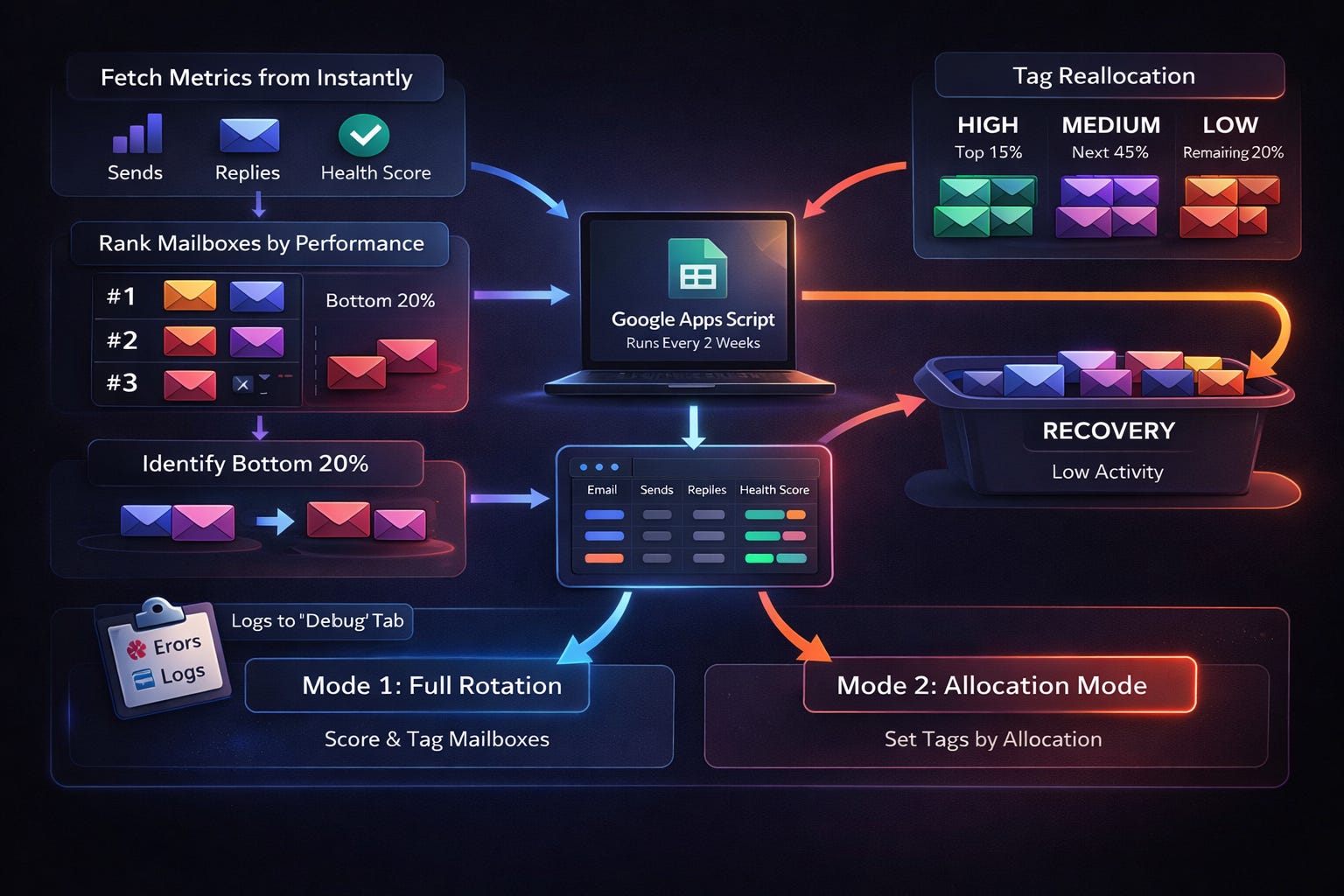
This image is an abstract representation of the tool I’ve built.
Pulls all the mailboxes for a client from the Instantly API and checks their reply rates and health scores over the last two weeks if it has sent a minimum threshold number of emails.
Sorts all mailboxes by a descending weighted score that combines reply rate, bounce rate, email health score, and number of sends.
Proportionally assigns every mailbox to one of four mailbox groupings based on its ranking
High - our highest performing mailboxes for our highest intent sequences
Medium - medium performance for medium intent
Low - so on and so forth
Recovery - The lowest performing mailboxes in this group will not send any emails for the next two weeks and then we will reintroduce them to the sending pool
We now resume sending and monitor reply rates every 2 weeks, repeating the above steps
Tracks performance of mailboxes by group and individually every two weeks such that we can see trajectory.
What am I missing from this configuration? What should I add? Would you subscribe to a product like this if I sold access for like $40/month or a price per mailbox?
Visibility
The second area i’ve been thinking a lot about is visibility, not just into what’s working, but where things are going wrong, how to find them; and most importantly, how to fix them.
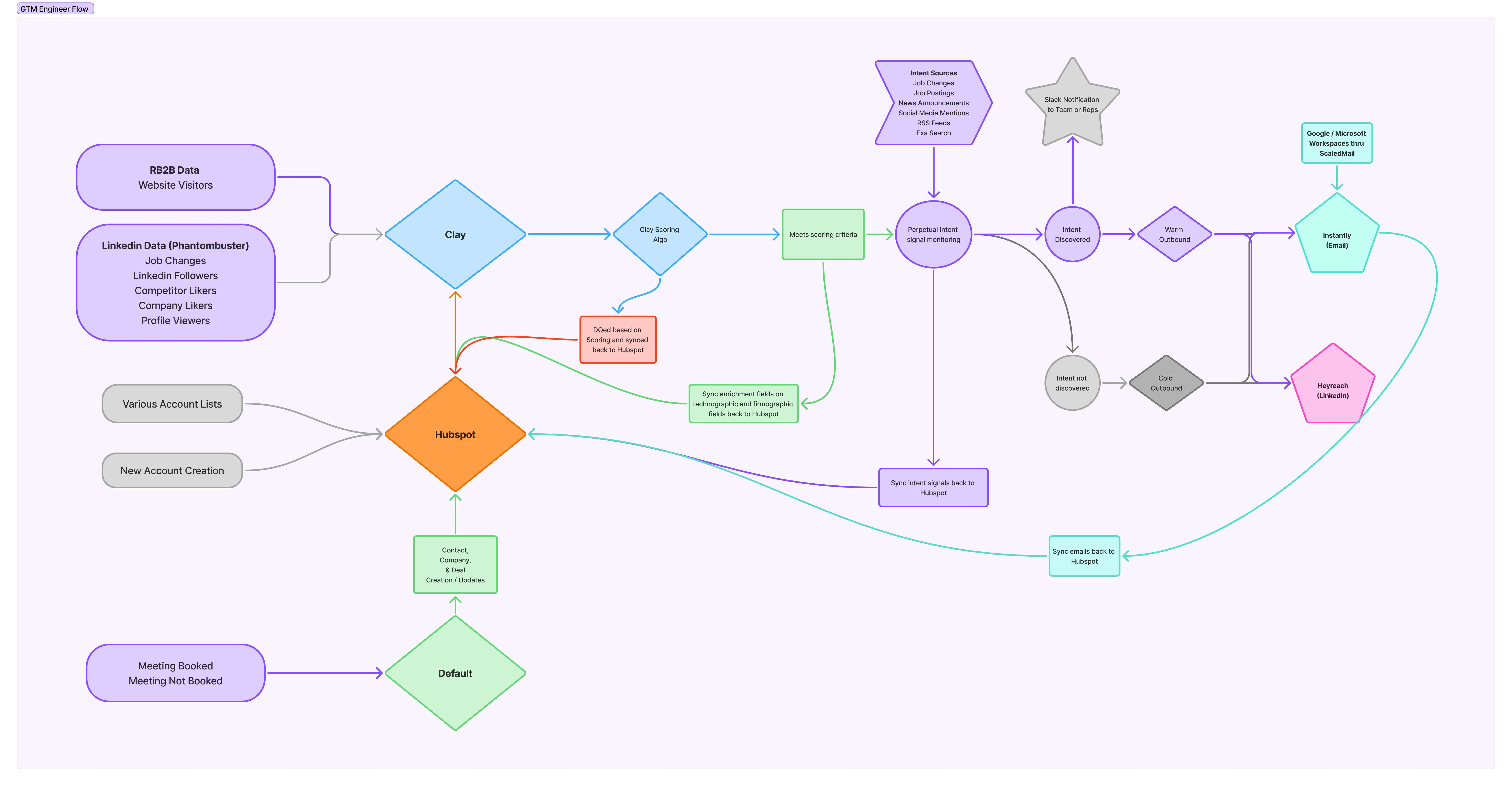
Building across a disparate set of tools ala Clay, Instantly, HeyReach, OutboundSync, etc results in GTME’s needing to track down why a email was sent with the wrong variable, why a email mailbox was disconnected, why an enrichment failed or errored out. With Clay in particular, I constantly need to sift thru dozens of tables to identify where the problem is and how to fix it. Annoyingly, sometimes I run out of credits and I’m not told which tables have been affected and when I buy more or get my credit top-up, I don’t know how to resume those failed runs without doing so manually.
This feels like a problem, and one worthwhile to fix (albeit it may not be a product in itself but rather a strong feature for folks who like to get in the weeds and manage these systems).

I imagine a world where there is a central mission control where GTMEs can see health focused notifications such as
Enrichments that were cut short due to insufficient credits
Leads can be tracked globally in each platform but also overall (so I dont need to login to all of my tools simultaneously)
APIs hit rate limits or errors
credit spending has jumped in areas with low historical usage
and so on and so forth.
I think this would be a GTMEs / Revops’s dream.
….
Is anyone out there making this or email / domain rotation a reality?
Let me know your thoughts below :)