The Impending GTM War: Outstanding GTM Needs
A few months ago, Clay announced a $100M raise; Unify announced a $40M raise about 6 weeks before.
Clay has done an incredible job building extreme depth and versatility in their product, becoming the power-platform for individual, mega-hacky GTM engineers. (But now they themselves are hiring AEs!!!)
Unify has always stood out as a far more user-friendly, scalable platform that can be used by full teams in GTM. It has dashboards, is end to end, and looks slick as heck.
It's the classic power versus convenience tradeoff, and both companies do a phenomenal job of owning their niche (and being upfront about it).
It’s going to be an all out war, and companies like Actively AI, Exa, Extruct AI, Sixtyfour, Origami and dozens more are following closely behind.
VCs are picking their horses and people are preparing for a wild battle in the modern GTM space (sorry old sequencing tools ;) ). Here’s what you should you be looking out for as a buyer, as an investor, or simply as a spectator:
There’s companies like Clay and Unify battling for market share with their opinions over complexity versus convenience.
There’s outdated incumbents like Apollo, Salesloft, Outreach, and more trying to stay relevant
Data providers are also moving into the outbound game like Sumble (raising nearly $40m USD a few weeks ago?!?!)

can someone explain to me how VCs put $40m into Sumble There’s at least 20 new GTM startups per year promising the world and trying to find their way
And there’s been little to no liquidity for anyone involved

I spent a ton of time in Unify’s product while I was there, and since doing my own freelance work, have been spending 40+ hours each week in Clay since then.
It’s more competitive than ever, and yet there’s still so much to do. I wanted to briefly share my thoughts on what needs to change for a player to truly cut through the noise and build in my mind what a definitive solution is.
Signal Prioritization

I touched on this in another substack but no one has yet figured out how to intelligently prioritize signals appropriately. Imagine one person shows 3 sources of intent, how does a system of action decide which signal to action on? In Clay you can build a mega-table of 100 columns to accomplish this (but few internal teams are doing this) and it still misses the mark based on the sheer amount of data / possibilities available.
Unify structures their Plays as individual workflows for each intent signal, but the only way to prioritize signals is to set time delays to ensure you action on one before the other.
I imagine this is very difficult to do, but a large problem that someone needs to find the answer to.
Finding Someone’s “Primary Current Job”
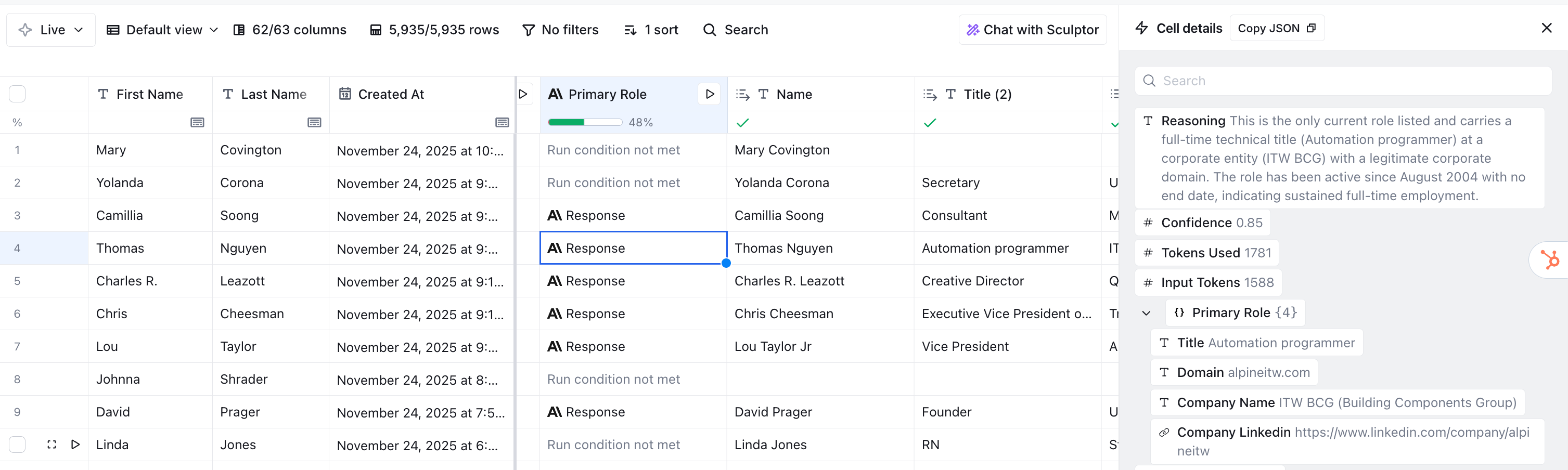
Weirdly an annoying problem I’ve run into across GTME work is determining which role for a person is actually their “primary, current full-time job”. There are people these days that have 15 jobs on their Linkedin (myself included). Board seats, angel investors, cofounders of multiple things. You can build an agent in Clay to discern which job might be someone’s predominant role, but this is a custom AI build, and not something that is available out of the box.
For Unify, as far as I know, this is not yet a thing. With Clay you can pull this off using AI, but this should be an out of the box AI enrichment and not a custom prompt IMHO.
Ultimately data will be democratized, someone needs to build rails to pull in someone’s entire job history, but importantly, which job is their actual full-time one that they have buying power for.
Storing / Leveraging Data Across GTM

Clay is incredibly powerful because data is stored in table form. If you’re organized in setting it up, you can refer to data across table and workf
lows, store data in CRM very easily, and thus use it wherever you want.
Unify is probably building some form of list functionality, but in order to earn the love and adoration of GTM agencies and hackier GTMEs, they need to build something that is far more configurable and customizable.
Title Classification

With some exceptions, Unify does an incredible job of qualifying / disqualifying titles. They use a simple include / exclude UI/UX that when setup thoroughly, tends to do the job well. It would be interesting to use AI as a component of qualifying a person based on their title as well, but for the most part, this end of Unify’s solution is very strong.
On the other hand, in Clay you can use their formulas to create a set of inclusive / exclusive title keywords, but the UI/UX is fairly messy and difficult to audit. What’s more, the formula tends to leverage substrings rather than full words. I am surprised they haven’t built better functionality here. However, their AI offering offers a great remedy here, I just hate incurring more API usage from my OpenAI API key.
Commoditization of Email
If Clay, Unify, and the hundred other automated outbound solution companies have their way, every business on the planet can use email to do lead generation far easier than they have in the past.
As users become further drowned in sales emails that they never signed up for, which platforms can build infrastructure for other workflows? Dialing, marketing, etc.
Unify certainly will build a dialer, Clay has fairly strong marketing use cases (their Webflow API connection is dope).
These companies need to expand past solely email / outbound more generally.
Venture Will Always Back Better GTM Startups

An existential question I always asked myself while working at Unify was “won’t there always be another better Unify / Clay?”
So long as GTM tech is closely tied to pipeline generation (trick question, it always will be), operators with GTM insight will always seek to build a tool that is 3%+ better than the last. And VCs will always back them, because heck - maybe this is the one that does it!
In this space in particular, it creates a never ending cycle of rip and replace.
If the 2010s marked the success of Apollo / Outreach / Salesloft and the mid 2020s marked the entrants of Clay / Unify being the hot new GTM companies, it wouldn’t be surprising if we saw another set of tools promising an improvement over Clay / Unify in the next 18-36 months.
We’re already seeing a massive influx of YC backed companies and other startups like Floqer, Sixtyfour.ai, Origami, Bitscale, and more.
Will this cycle end? I think not, but the ones that will survive will be extremely opinionated on what they want to build, and more importantly, for whom.
Jack of Trade (master of none) - So many of these platforms ultimately land up building everything. Their UIs go from elegant to bloated and drowned with features (Apollos sidebar is the most crowded thing I have ever seen, I sweat every time I login). Choose what to be a master at and don’t enter into spaces you can’t win in
This means companies pick a handful of features and crush them, and don’t deliver things outside
Brand - those that capture mindshare and build sustainable and relatable brands will take the cake. Unify and Clay have done an exceptional job with this.
Unify anchors the brand in futuristic workflows, modernity, and simplification
Clay anchors the brand in fun / creativity, but also depth and complexity
Future-Proof - don’t build a company that just sends emails if we believe email is dying. Diversify your bets and be sure to enable other sources of pipe-gen to be a big part of your product.
Ease of Use
While everyone has one (an email), the science behind email is actually quite complex. And to be frank, few people really have a deep understanding of how email deliverability actually works. Unify and Clay both employ enormously large success teams, external partner agencies, and more - it takes months to see success and has created a massive headache for companies in onboarding and ongoing success.
Clay is an incredibly complex product which I love for that reason, but for most people it is far too complex (even with Sculptor). Unify is far simpler, but sales folk still don’t want to build 800+ different plays and constantly manage their dependencies.
Switching Costs
Everyone cringes at the thought of switching systems. And with how deep tools like Clay go, I can not fathom needing to rebuild my workflows in Clay in another tool. For how painful Clay is, I know that I can go extremely deep and be extremely precise, and evaluating other tools is something I enjoy recreationally, but I genuinely wonder what it would take for me to truly migrate my workflows from one to another.
Moreover, I continue to see GTMEs fight over the classic bundling/unbundling conundrum. Will tools win that are able to do “everything”? Or should tools stay opinionated on one to two areas that they know that they can perfect those workflows.
Evolution of Business Development
Do we collectively believe BDRs will cease to exist?
Will there be a small set of elite BDRs that work in conjunction with GTMEs?
Every company has an opinion, and while we will most certainly land up in the middle, I tend to believe there will be more automation and less typical BDRs in the future. If i can send 1,000,000 emails in a month as one persona and optimize my stack and funnel to achieve a 2% positive reply rate - that’s 20,000 positive responses. Of course there are costs of such a system, but the bar we are setting for BDRs to compete is unrealistic to expect of them!
What About Non-B2B SaaS?
The most interesting takeaway I’ve had working in this space is actually how valuable lead-gen and GTME work is to non traditional B2B SaaS spaces. I’ve been doing work for some niche PE firms, construction businesses, physical guarding / security businesses. There is such a severe gap in technology for these companies, and they undoubtedly have the most to gain.
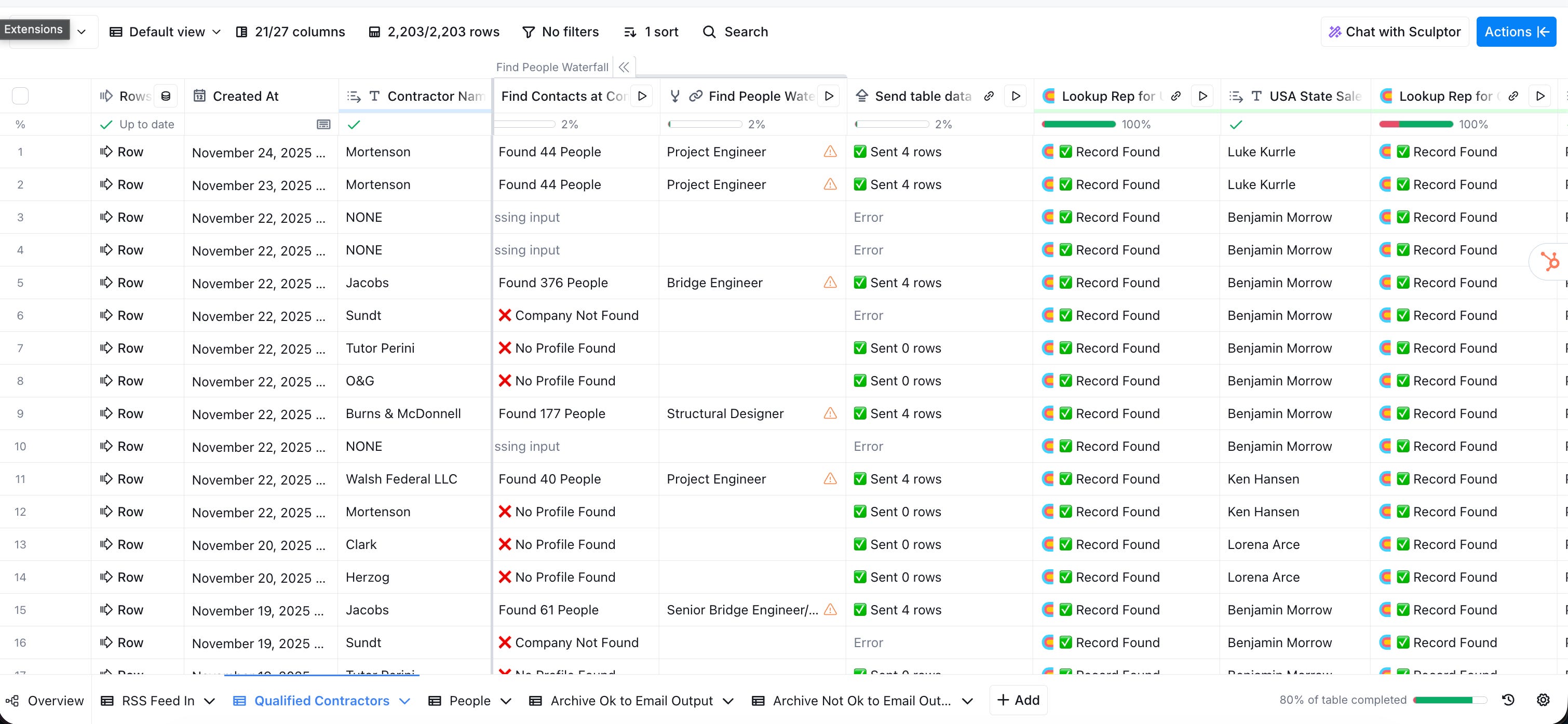
Clay’s RSS feed is a testament to this, it is their least marketed part of their product, but the area I have seen by far the most initial success from.
I can ingest any RSS feed (so pretty much any news article on the planet) and use it to conduct outbound? That’s relevant to nearly every business on earth. If someone on Clay’s CS / Marketing team is reading this, reach out (unless Brett Fischler ships something first :))!
Mailbox Rotation
Referencing back to the email being a black box, the fact that email tools (Instantly, Apollo) and Unify / Clay have not figured out domain rotation / optimization yet despite citing it is insane. We should be building these companies to generate pipeline with less emails, not more, and its incredible that I need to build custom scripts in Google Appscript or Cursor to interact with Smartleads / Instantlys API rather than these products having solutions out of the box.
Dashboarding & Reporting
Being able to concretely show ROI for business users is just as important as actually delivering that ROI. Unify’s dashboarding is quite beautiful but historically has loaded slower. Clay certainly will drop something in this category, hopefully its lightweight and feels easy to use.
Other Niche GTM Edge Cases
We need these outbound platforms to routinely check for updated contact info on a recurring basis irrespective of the “intent source”, as these leads die immediately (in an outbound sense) if contact info isnt found / is stale
Being able to copy paste workflows / nodes / columns across workflows. A lot of workflows have the same plumbing, Zapier does a great job at this
The GTM workflow for teams of all sizes / spaces is changing fast, it will be exciting to see how this all plays out