Unify vs. Clay -> it's all about how you're doing the work

TLDR:
Unify → BDR tool as modern Apollo replacement,
Clay → Table-stakes hacky GTME tool
It’s been really interesting having left Unify and seeing the wealth of other available tools out there for revenue teams. I’ve personally spent time in a handful of newer tools (SixtyFour.ai, Origami) and am now revisiting others I stepped away from while buried in Galaxy work.
Over the last few months i’ve gotten a tremendous number of questions on Clay vs Unify. So I wanted to write this to give those who don’t know Unify or Clay a view outside-in of what they can be used for and where each one wins.
We never really know why we’re better than our competitors

I find it particularly interesting that in work, as in sports, as in life - we’re ultimately battling opponents day in and day out; however, we rarely see things from the opponent’s point of view.
I used Unify daily for 13 months while I was there in 2024-2025 and I’ve now used Clay daily from early 2025-to today. I’ve also implemented Clay across dozens of teams and have made recommendations on how to use both - there are likely few other people who are better suited to write such a comparison.
And of course keep in mind that this is but a small screenshot of both tools today January 2026. This is not a feature-by-feature teardown. It’s a comparison of how these tools think about work.
The Real Tradeoff: Systems of Action vs Systems of Data
Unify and Clay are very different tools. They’re used for many of the same things but they go about it in completely different ways.
Unify is an action-oriented platform that prioritizes outbound execution, while Clay is a data-first system designed for observation, iteration, and reuse.
Where Unify focuses on building an action oriented HQ for conducting outbound for BDR teams, Clay is a surgical observatory where you can collect data, manipulate it, and choose what to do with it. Your two choices are outbound fast, or data then action slow and steady.

Almost every difference between Unify and Clay is downstream of this tradeoff.
How Work Actually Gets Done in Each Tool (Plays vs Tables)
Unify
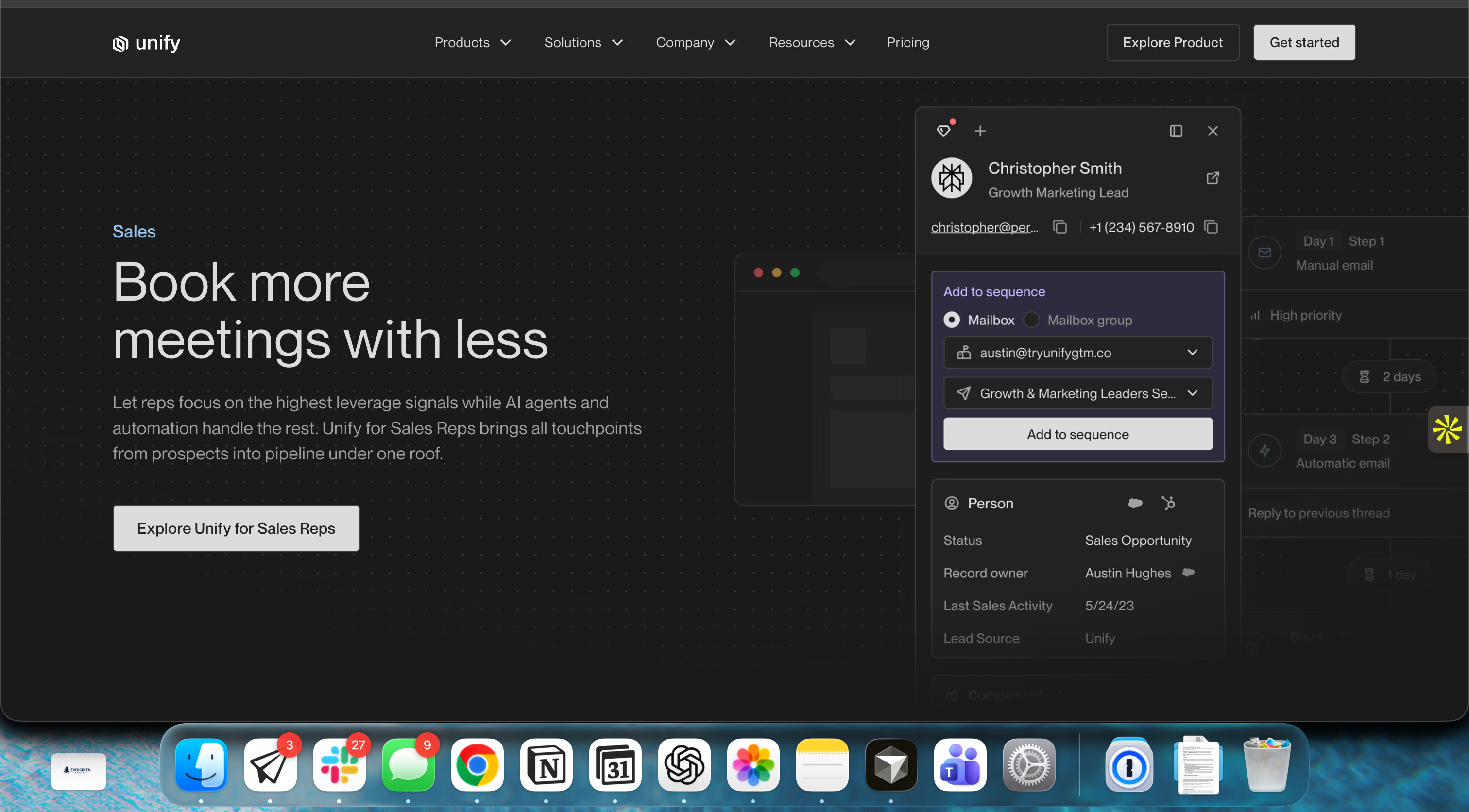
Unify was built first and foremost to be an outbound tool. While they started with GTME outbound automation, they’ve headed more down the BDR tooling route since Q2 2025. Unify is essentially ripping and replacing Apollo/Outreach/Salesloft at breakneck pace because of how slow those players are to innovate and because of the clunkiness of their 2000s/2010s UIs. The platform allows teams to centralize intent data (and see a historical view of intent data too in one “Activity Feed”), find folks at various accounts for you, and then create a backlog of emails (tasks) that BDRs can write without leaving the platform. It makes it easier to be a BDR.
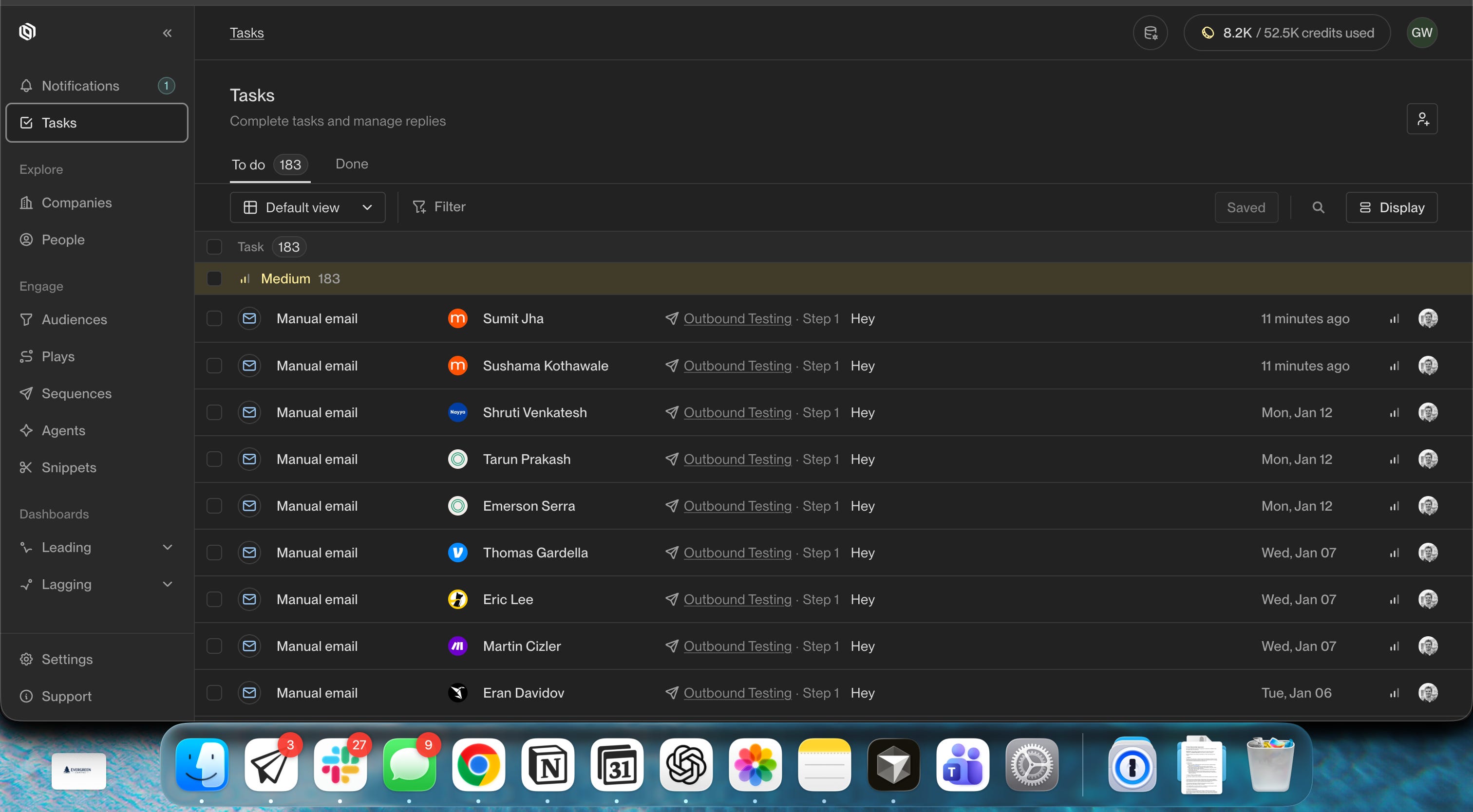
That should tell you a lot about what the team is building right now → A BDR automation tool with some of the tooling for GTM engineering automation. Unify is very much a system of action for BDRs who want to see what accounts are showing intent.
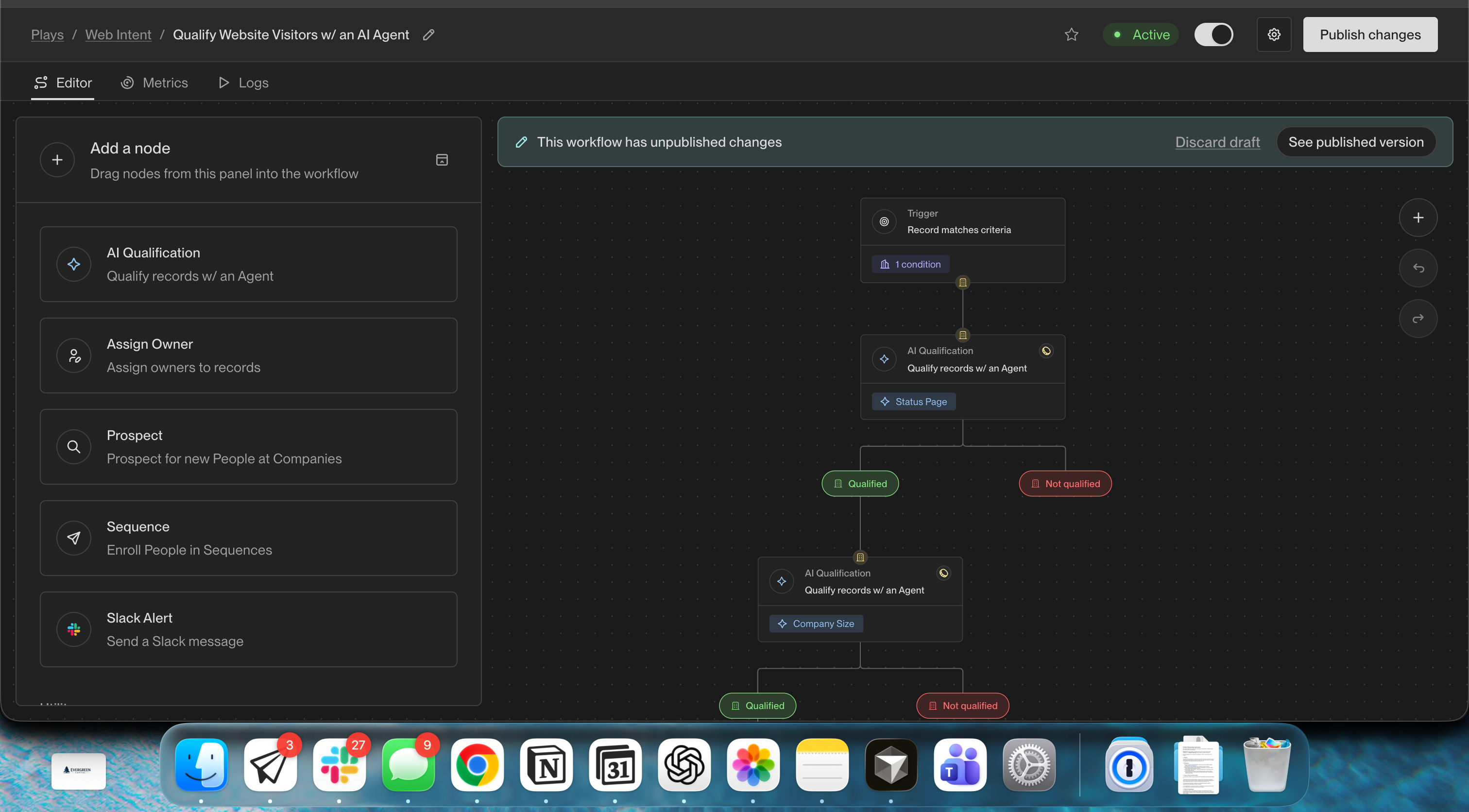
Unify’s workflow revolves around what it calls a “Play” (a workflow) based on some type of trigger such as intent (website visitors, Linkedin followers) or other sources (CSV upload, etc.).
Using a Zapier like interface, you can build a workflow based on set logic, AI qualification, prospecting for people, and ultimately outbound campaigns or “Sequences” as Unify calls it.
You start with a set of Companies, use AI to do some qualification, Prospect for People (and enrich) with certain titles, and then enroll them into sequences.
This allows you to quickly create a set structure for how outbound should run in set environments under certain conditions.
Much of Unify’s speed comes from how opinionated its prospecting and qualification model is. Companies and people are surfaced as CRM-known, Unify-known, or net-new, with simple title inclusion and exclusion logic that trades nuance for velocity. Reusable components allow teams to update workflows globally without rethinking the system.
Unify is geared towards BDRs and optimizes for outbound execution speed and set workflows
Clay
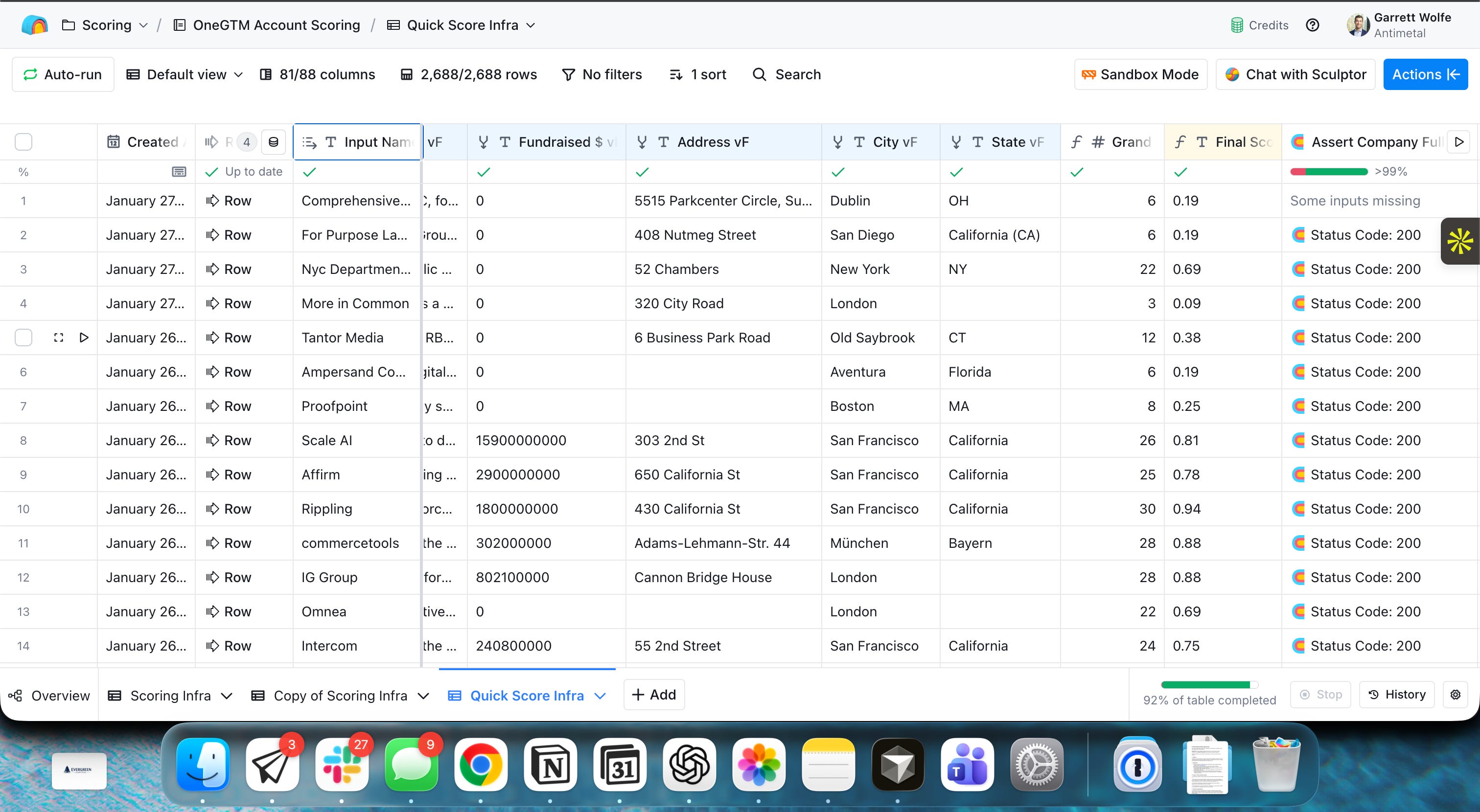
Clay on the other hand is the love child (as I say) of Excel, LinkedIn, and ChatGPT. It is a tabular interface that allows you to conduct incremental operations on data such as data enrichments, AI analysis, and even lookups in other tables. Across any given client I work with, I have dozens of workbooks (a collection of tables) and dozens of table lookups, CRM lookups, and more.
For example I might start with a company list, pull in 5 sources of data, normalize all of them, score, them, and more all using the table interface. I might reference other data tables and data points, and more.
There are hundreds of integrations and the tabular experience allows you to step thru your “idea” for growth, creating one column at a time, and work thru one step at a time.
This table-first approach is what enables Clay’s power. Data can be reused across tables, enrichments don’t need to rerun, and APIs are first-class citizens rather than add-ons. That’s why Clay often ends up being used for far more than outbound, from scoring to recruiting to TAM analysis.
Clay optimizes for reusable data and highly bespoke, piecemeal workflows.
Where Unify Clearly Wins (and Where It Doesn’t)

As a GTME tool, Unify wins for teams that want to leverage intent data to do outbound but don’t want complexity and don’t care about data configurability / Revops as much. Given its a ton easier to set up and less daunting to troubleshoot, it’s far easier to spin up here.
As a BDR tool, Unify has a beautiful interface that modernizes on top of much of the functionality that Apollo won over BDR teams with years ago. Much of the work that I spend building Views for in Hubspot or other CRMs is somewhat out of the box in Unify’s Audience views - meaning teams can see where and when intent took place (though Unify doesnt make it as easy to view custom CRM columns within Unify. Unify believes there’s no need for external data sources, or multiple tools, it can and should all live in Unify. Not needing to deal with 4+ external tools is part of the appeal of Unify (but also one of the downsides). Is the quote “jack of all trades, master of none” true?
Cost sensitivity, data quality prioritization, lots of integrations, 3P APIs → these are areas that Unify does not take the trophy in today.
Where Clay Clearly Wins (and Where It Doesn’t)

As a GTME tool, Clay is a dream platform for technical GTMEs. Complete cost control with external integrations, piecemeal and iterative operations, cross workspace/environment lookups, and more make Clay a must-have for GTMEs looking to focus on data cleanliness, data validation, and ultimately agility in building GTM workflows.
Even though Clay is building rep tools this year, I simply can’t imagine they build this in a tasteful enough way that BDR teams use it and like it. It’s just too complex of a product and I think itll be hard for them to switch from technical personas → way less technical.
GTME’s love it because of its configurability and the driver’s ability to optimize for control, cost, and reuse of data.
But at the same time, for many folks Clay is overly complex, is difficult to onboard a whole team onto and share ownership, and also has a weaker prospecting engine. When I first started using Clay I was simply overwhelmed by all the complications in workflows that Unify to an extent has simplified.
Why These Tools Will Never Converge

As I mentioned, Clay and Unify are built for two different types of people. And while I think everyone wants to to be the “categorical winner”, I don’t know if either tool will be able to satisfy both sides of the market - notably, technical and non-technical.
At most companies, Unify is owned by sales leadership and operated daily by BDRs, while Clay is owned by a single technical GTME or an external operator who becomes the system’s steward.
These products are opinionated not just in features, but in who they believe should be doing the work.
What makes Unify beautiful is its simplicity and UI / UX.
What makes Clay incredible is its sheer depth, attention to detail, and power.
Unify fails quietly by being limiting. Clay fails loudly by being overwhelming.
They both will try to overtake the other, but I feel as though the way to truly win is to stay extremely opinionated not only what you are building, but who it is intended for.
Just as Clay’s API and integration features will never be useful to a BDR, Unify’s quick account research and “tasks” will never be useful to a GTME.
The end
I’m including my bulleted notes on both platforms below that go into further detail if you’re really curious, but this is where the meat of the substack post ends :)
GW
Appendix Notes
Unify
TLDR: outbound, simplified, fast
A lot of the secret sauce in Unify’s workflows come down to a handful of key areas
Prospecting - finding people and companies
This is one of Unify’s standout features, focused predominantly on surfacing people who exist in a few different categories:
exist in your CRM only
exist in Unify (Unify has “found them” before)
exist in neither Unify or CRM (net new)
Title Filtering - contains a beautifully simple inclusion / exclusion logic in a nice format. Though this lacks an AI component / reasoning which would be a great incremental improvement
Plays - Fairly easy to spin up each signal in a visual workflow canvas where you can see the movement / qualification of leads.
Fairly fast time to spin up an MVP as it feels akin to other tools and everything from signals, prospecting, data to outbound sit under one roof, making it easier for your team to get a centralized view of all the intent that exists for your company
BDR focus
The BDR tool was born out of customers asking for a newer version of Apollo for their BDRs. BDRs spend time in Apollo making sequences, then ultimately explore Linkedin all day and drop folks into sequences using the Apollo Chrome Extension, which is highly manual
Unify basically said lets reimagine this in a more modern way. We’ll centralize intent data with Unify, find folks at various accounts for you, and then create a backlog of emails (tasks) that BDRs can write without leaving the platform. It makes it easier to be a BDR but I feel as though this too will soon outdated and if BDRs continue to underperform long-term, this will become less valuable
Single Pane of Glass
Unify has “Activity” views for each Company and Person so you can see what intent signals and outbound has occurred for each entity. For BDRs this is incredible to see when the last time someone was contacted, etc.
This is very akin to making a “View” in something like HubSpot for reps.
Reusable Components
Unify makes it very easy to effect change across all your workflows seamlessly, with reusable and easily globally updated Components (an area that Clay is beta testing right now with Functions).
Pros
Fairly simple to setup (relative to Clay)
Is liked (as far as I know) by BDRs as a modern replacement to Apollo
Doesnt require AI usage to generate snippets (this may change and costs for this are soooo low via Clay but just flagging)
Has a beautiful interface
Solid reporting and dashboarding which is slow / difficult to use today but will likely get a overhaul in the future
Truly unifies the stack across things like RB2B/Vector/6sense (website visits), Clay (workflows and signals), Warmly / Common Room (signals), Instantly/Smartlead/Lemlist (email), HeyReach (not yet but linkedin messaging soon I think?), making it far easier to manage for one or a few people
Cons
Additional Signals
Today Unify supports website visitors, new hires, job posting, Lookalikes, and any signal that can be gauged by a recurring websie search using AI (product announcements, event attendance, etc.).
They will be adding a ton more in 2026 however
No “table” experience.
This is an area that Unify will certainly change, but it does not have a table experience. This means that while the product is easier to use, its difficult to store, retain, and reuse information across the Unify platform. This is one of Clay’s strongest features.
Lack of APIs
As of this writing, Unify still does not have an API to pipe in and out data from other sources. CSV, Unify intent, and CRM are the only way to get data in and out. I believe it’s only available in Beta to Enterprise customers
Concretely, this means all enrichments and funky signals / imports / export require usage of Unify Credit’s rather than using external APIs which might be cheaper all-in.
Thus access to other email tools, custom API calls, etc are all not possible.
No Scoring
Clay has a decent scoring UX, but Unify is more binary here - a Company or Contact is or is not qualified.
Miscellaneous
Agent outputs can not be formatted into highly specific JSON
No ESP matching
Has to include unsub links, no “respond pause to remove” without a link
Harder to edit email formatting / copy
No unified inbox experience yet
Price Point
$25K/year for base plan
Summary
Unify is an exceptionally gorgeous product that serves teams who don’t care about the price tag with intent led outbound super quickly. What it lacks in customization (and complexity), it makes up for with simplicity and provides a modern BDR experience as well. It is truly a reimagination of an outbound tool, purpose built for BDRs and single GTMEs, but lacks the functionality for real GTMEs or Claygencies to use effectively.
I recommend this for folks who want to get their outbound up and running as fast as possible in a straightforward way without a full-time GTME who will spend all day optimizing their outbound. Best fit for BDRs who need a bit more hand holding
Clay
TLDR: A data nerd’s best-friend for reusable data and GTM workflows
Now before you read into this too much, keep in mind that Clay has been around far longer than Unify. I am also biased but have used Clay for hundreds of hours (if not more) over the last 9 months. They have built an exceptionally powerful product for people that like staying up till 4AM to show their friends what they built. Sometimes I am terrified by how plugged in I can get because of how hacky it feels. This week alone I stayed up till 3AM a handful of nights experimenting with new workflows. Clay is an exceptionally complex product and will likely not ever be able to unwind that vibe, but I don’t think it should. It is a highly opinionated product on “data is core to GTM” and that is what makes it stand out. Yes, it is fucking difficult to use and sometimes I want to claw my eyes out, but wow is it powerful.
Features
List Building
Large suite of 3P data sources
Table view with ability to conduct workflows “one step at a time” and see / test results before continuing
Highly configurable and ability to reuse data across tables such that enrichments don’t need to run over and over again.
Access to API calling
Making virtually any API accessible via Clay, making niche 3P signals and platforms easily within use
Can use AI for Complex operations like
Determining someones primary FT job
Cleaning names of people, companies, etc.
Has functionality that makes it far more than just a outbound tool - recruiting, scoring, even TAM builds, etc.
Cons
Clay is not a product for BDRs as it is highly complex
The design and clunkiness of the product can be frustrating at times
In many areas it lacks organization and throws everything at you and expects you to sift through it (sorry)
Lacks in reusable components in my opinion (despite functions beta-roll out and within Claygents / otherwise)
Fairly steep learning curve
Poorer prospecting engine when compared to Unify (imo), lots of Claygencies use 3P prospecting APIs (Apollo, LeadMagic, etc.)
Owned by one person internally or a external agency / claygency
Pricing
Cheaper by 2-3X.
Summary
Clay is an incredibly powerful product that has no intention on being one used by Sales people, rather it is intended to be used by folks with systems thinking, a desire for hackiness, and building workflows that can empower everyone from sales, to marketing, to hiring in various ways.
While Clay is priced at a cheaper price point, credit overages, the need for a user to configure and optimize constantly, and more make it difficult for team’s who have limited time or FTEs to work on this workflow.
If you want to be the hackiest GTM expert on the planet, Clay is certainly the right tool for you and I tend to recommend it for teams that want to build the most bespoke workflows
Takeaways
For team’s that want to do simplified automated outbound fast and have the $ to work with, Unify is a beautifully simple platform that will get you outbounding on your first set of signals within a few days (post-mailbox warming). I’d recommend it for folks that want BDR led outbound.
For team’s that want extremely configurable data enrichment, outbounding on a variety of different signals, and way more control of what they’re doing, Clay is the way to go. Though they’ll need the time, sanity, and patience to get there!
As always, ping me to get in touch for advice, advisory work, or implementation of your GTM needs, whatever they may be!